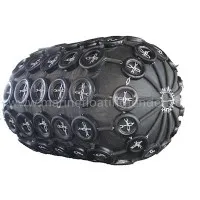


Qingdao Luhang Marine Airbag and Fender Co., Ltd. is one of the leading manufacturers and suppliers of 80kpa pneumatic rubber fender in China. We warmly welcome you to wholesale customized 80kpa pneumatic rubber fender at competitive price from our factory. If you have any enquiry about quotation, please feel free to email us.
Product disctription

Luang manufactures pneumatic rubber fenders with 50kPa and 80kPa initial pressure. We strictly produce the pneumatic rubber fender with ISO17357. We have our rubber machine and volcanized boiler; We can control the whole process ourselves. All the pressures, such as internal pressure, endurable pressure, safety-valve setting pressure, and hydraulic test pressure, are also up to the standard of ISO 17357:2002.
What is 80 Kpa Pneumatic Rubber Fender?
The Yokohama Fender) is an abrasion-resistant rubber fender filled with high-pressure air. It can easily be deflated, which allows simple and cost-effective relocation and re-commissioning in other locations.
Two different internal pressures cover a wide performance range. They are produced by ISO 17357-1:2014. Pneumatic Fenders can be made using various methods, each with advantages when compared correctly. The most common methods are molded and wrapped. Airbags should not be mixed up with Pneumatic Fenders; airbags are used for ship launching operations and thus serve a different purpose than Pneumatic Fenders.
The requirement could customize all sizes.
Pneumatic Fenders Classification
Fender Pressure Rating
There are two initial pressures:
■ Pneumatic 50 (P50, Initial internal pressure 50kPa)
■ Pneumatic 80 (P80, Initial internal pressure 80kPa)
Pneumatic Fender Type
There are two common types of Pneumatic Rubber Fenders.
■ I - Net tyre --Covered with a chain net, wire net, or fiber net for small-size fenders
■ II - Sling -- This fender has a lifting device on each end, which shall be connected with a guy chain or rope. Without a protection net, it is easy to handle with lightweight)
Fender's Protection Net Type
Net-type fenders (TypeⅠ) are covered with a chain, wire, or fiber net. Each end of longitudinal chains, wires, or fibers is linked with one or two ring(s), which shall be connected with a guy chain or rope. Usually, these nets use tires together with rubber sleeves for additional protection to the fender body, except for fiber nets, which have only rubber sleeves.
Advantage
1. Easy to install and maintain
2. Low reaction and hull pressure
3. More suitable for small and large tidal ranges
4. Lower maintenance cost
Characteristics of Pneumatic Rubber Fender
- High energy absorption and slight reaction to ensure that the hull and dock wall remain undamaged.
- Simple installation allows for easy carriage and deployment on any ship, in any waters, unaffected by tides or ship size.
- Excellent resilience ensures the product maintains its shape despite the forces exerted. After compression, the fender immediately regains over 95% of its original shape.
- Every step, from raw material procurement to product inspection, is meticulously carried out to ensure quality.

Uses of Pneumatic Rubber Fender
Inflatable fenders are mainly used to protect ships from collisions with docks. It can significantly deflect and reduce berthing energy without causing permanent damage to the hull or concrete of the berth. Yokohama fenders are very suitable for short-term ports of call, maritime cargo transfer, buoyancy assistance, and double berthing of ships. Chains and shackles should be installed on the pre-installed base of the dock to make the fender float horizontally on the shore and adapt to the berthing of the boat under the changing water level of the tide.
Yokohama pneumatic fenders can also be installed on both sides of the hull to avoid collisions between ships. This operation is also known as STS, which is more common in the handover of liquid cargo at sea. Sometimes, ships need to do double berthing operations; a boat is moored in the port, and there is another berthing method on the outside with the moored vessel. This berthing method can quickly and effectively transfer cargo, improving the efficiency of cargo transshipment at the terminal.
In addition to the most basic method of use, pneumatic fenders can temporarily provide buoyancy for the vessel, preventing the vessel from bottoming in some shallow water depths.
Why choose us

As we are the original manufacturer, we can offer you:
1. Price from the factory directly
2. With more than 10 years of experience specializing in floating rubber fender, we supply products with good quality, various designs; any customized design is highly appreciated
3. Satisfied service
4. Short lead time and strict quality control
Tips for Using Pneumatic Rubber Fender
- Fender pressure should be maintained within the standard pressure range of ±5%.
- Regularly check the pressure. If it drops, promptly inflate the fender to prevent any disruption to its regular use.
- Avoid touching the fender surface with sharp objects to prevent punctures. Damage to the fender surface will affect its service life.
- If the fender is not used for an extended period, clean its surface with water and store it in a dry, cool, ventilated place away from direct sunlight.
- When storing the fender for a long time, reduce the pressure and keep it away from heat sources.
- When storing the fender, do not fold or stack it, and avoid placing other items on top of it.
How to Choose Marine Pneumatic Rubber Fender?
Many fender types, such as cylindrical, V-type, A-type, M-type, supercell, and super cone, can be used on the port. Tugboat fenders, however, are installed on tugboats to protect vessels from a significant failure in the incidence of a crash. To achieve the best result, there are several factors to consider in choosing the right type of marine rubber fender, namely the dimension of berthing vessels, the type of the port, the situation around the port, and the existence of a tugboat to guide the ship while berthing.
Vessel Dimensions
Vessel dimensions, in terms of type and dead weight tonnage, become significant factors in choosing the right fender type, as well as the size of the fender. The larger the vessel, the larger the required fenders will be. Usually, fenders equipped with frontal frames are chosen as they have large contact areas. From an economic perspective, a V-type fender is one of the options. However, to yield the maximum result, supercell and super cone fender are selected; for the ports used for the small to medium vessel, the type A, V, M, LMD, or cylindrical are chosen to protect the port wall.
Type of the Port
The port type is another significant factor influencing the choice of the right fender. Based on the location and position of the port, several port structures are usually used, including dolphin, monopile, jetty, and quay wall. The dolphin terminal consists of poles that are used to berth vessels. The rubber fender that is usually used in this terminal is the supercell fender. However, a jetty terminal, also known as a floating terminal, does not need a rugged construction as it floats. This terminal is used for passenger ships. Unlike other ports, terminals with quay walls consist of concrete structures that parallel the beach. Large vessels cannot berth on this terminal due to the shallow waters in which the terminals are usually located.
The Availability of Guidance During Berthing Process
The availability of tugboats during the berthing process is critical to prevent vessels from crashing into the port wall. This is because the boat's speed and berthing angle can be adjusted as the ship moves closer to the port.
Hot Tags: 80kpa pneumatic rubber fender, China 80kpa pneumatic rubber fender manufacturers, suppliers, factory, fendering system for marine container ships, marine yacht fender, catamaran fendering system for marine, fender for marine ports, marine catamaran fendering system, marine fishing boat fendering system