


The application background
When the vehicle stops underwater due to a power system failure, or water enters thecare due to an accident, the occupants will take out the four emergency equipment devices carried with the car and hang them on the two sides of the equipment (designated positions). They will then pull the quick-release valve to quickly inflate the emergency salvage airbag to create buoyancy, increasing the time for self-repair and waiting for rescue at sea.
The consist parts
| No. | Name | Qty |
| 1 | Airbag | 4 |
| 2 | Packing bag | 4 |
| 3 | fixtures | 8 |
| 4 | Storage Box | 1 |
The TPU Emergency salvage airbag comprises airbags, packing bags, fixtures, and storage boxes.
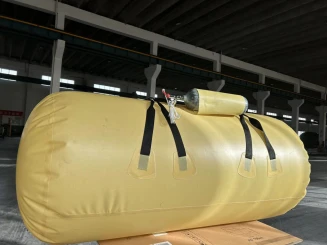
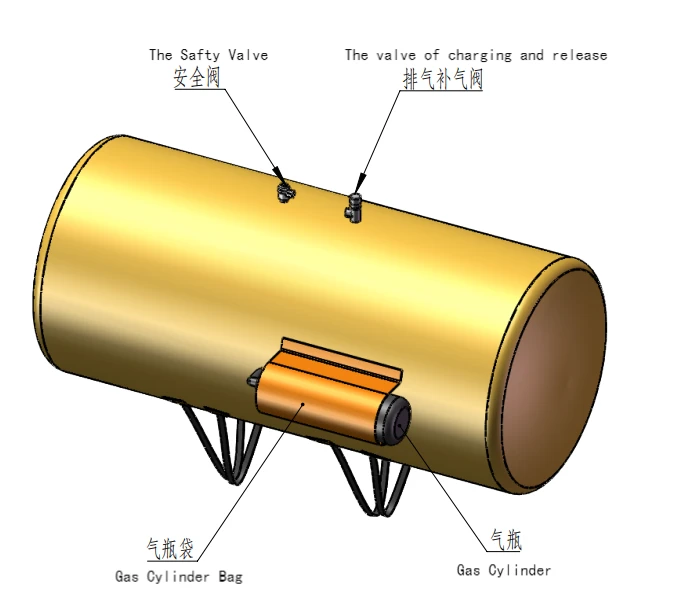
1. The airbag (see Figure 1) is the essential component of the flotation device to generate buoyancy and is mainly composed of the airbag body, inflation system, and connecting mechanism.
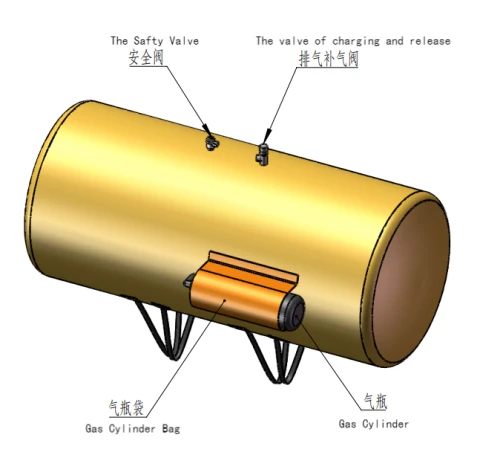
a. The airbag body (see Figure 2) is formed by cold bonding of XB-11 cloth and is equipped with a safety valve, an exhaust and air replenishment valve, an inflation connector, etc. The safety valve can ensure that the airbag pressure is not too high and the airbag is damaged; the exhaust and air replenishment valve is used for exhaust and air replenishment when the airbag is inspected for strength and air tightness; the inflation connector is connected to the inflation system to introduce the mixed gas in the gas cylinder (containing alcohol: 20g; N2: 80g; CO2: 2.6kg;) into the airbag.
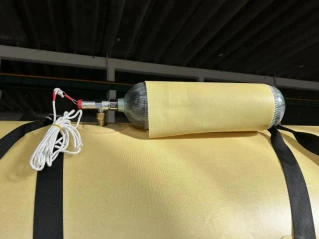
b. The airbag has an independent inflation system (see Figure 3), mainly composed of a carbon fiber gas cylinder, a quick-release valve, etc. The quick-release valve is installed on the head of the gas cylinder. Pull the cable on the quick-release valve, and the striker on the quick-release valve will penetrate the diaphragm on the gas cylinder to release the gas in the gas cylinder. The released mixed gas is transported to the airbag through the inflation joint, and the airbag generates buoyancy in the water after expansion.
c. The connecting mechanism (see Figure 4) mainly comprises a connecting belt, a stainless steel spring hook (hereinafter referred to as the spring hook), and a fixing device. The connecting belt is fixed to the airbag and ensures that the buoyancy generated by the airbag is transmitted to the spring hook; the spring hook is used to restore the airbag to the fixing device on the vehicle body (a fixing device specially used for connecting the airbag); the fixing block fixes the two ends of the connecting belt together.
2. Packaging bag (see Figure 5) To minimize the airbag volume when it is stored on the amphibious armored equipment and prevent the sharp objects in the vehicle from damaging the airbag, each airbag is placed in a unique packaging bag. After loading the airbag, the packaging bag is sewn with polyester-coated cloth and sealed with a nylon zipper. The inflatable zipper of the airbag can be automatically expanded.
3. Fixing device (see Figure 6) The fixing device is mainly used to hang the flotation device on the vehicle body and transfer the buoyancy generated by the airbag to the vehicle body. The fixing device consists of a semicircular ring and a bottom plate, fixed to the specified positions on both sides of the vehicle body by welding.
4. Storage box (see Figure 7) To facilitate the installation, transportation, use, storage, and maintenance of the flotation device and amphibious armored equipment, the flotation device is stored in a storage box. The storage box consists of a box body and cover made of alkali-free glass fiber cloth bonded layer by layer by unsaturated polyester resin.
The specification
| No. | IItem | Description |
| 1 | Weight | 25 kg/set |
| 2 | Airbag | The working pressure is 11Kpa; The size is φ910*2010 after inflating. |
| 3 | Gas Cylinders | The volume is 4.7L; The inner pressure is 10MMpa; Gas composition: nitrogen or carbon dioxide |
| 4 | Airbag forming speed | full charge in 1 minute. |
| 5 | Outer Packaging | Size: 400mm * 855mm * 510mm Material: Polyester fabric, nylon zipper |
The airbag material performance
| The material of airbag | Thickness | Break Value | Elongation at break |
| Double-sided TPU with nylon mesh | 0.46mm±0.05 | Warp:≥27kn | ≥33% |
| Weft:≥21kn | ≥48% |

The Precautions of the TPU emergency salvage airbag
1. Precautions for using gas cylinders
(1) Before a single set of airbags is hung on a fixed device, be sure to pay attention to the direction; the cable on the quick-release valve always faces the middle of the vehicle body.
(2) When pulling the gas cylinder rope, quickly pull the cable on the quick-release valve until it is completely separated from the airbag.
(3) carbon fiber gas cylinders must have protective covers during use. Be careful not to scratch the gas cylinders with sharp objects. They must be sent to professional manufacturers for repair and identification if scratched.
(4) The safety valve cover must be open during use.
(5) When using emergency flotation devices at sea, if it is found that one side of the airbag fails to open in time, causing or accelerating the risk of equipment tilting, you can deflate it by unscrewing the air valve or scratching the airbag with a sharp object. (This method is generally not used unless there are exceptional circumstances).
(6) When the equipment is not worth repairing, use the spring hooks on the airbags to hook each other for self-rescue of the occupants.
(7) When connecting the gas cylinder to the quick-release valve, use two wrenches to tighten it to prevent damage to the quick-release joint of the airbag.
2. Precautions for the use of safety valves
If the internal pressure exceeds 22kPa and the safety valve does not open, stop inflating and unscrew the safety valve to check whether the safety valve is damaged. If it is damaged, it should be replaced. When replacing the safety valve, unscrew it from the valve seat and replace it with a new one. Usually, the safety valve is adjusted to ensure safe opening and closing pressure when it leaves the factory. Please do not twist the safety valve at will when using it.
After the safety valve is closed, use an air compressor to inflate the airbag through the inflation valve to adjust the airbag pressure to 11kPa, record the ambient temperature, and after parking for 4 hours, after temperature correction (for every 1℃ increase in temperature, the residual pressure is reduced by 0.39kPa, and for every 1℃ decrease in temperature, the residual pressure is increased by 0.39kPa). The residual pressure in the airbag is not more than 5% to be qualified. If the airbag fails to meet the airtightness requirements, it can be returned to the manufacturer for repair or patching. The airbag should be re-checked for airtightness after repair, and the inspection and repair results should be recorded in the corresponding column of the resume. (The repair adhesive must be prepared two hours before use and has a short validity period. Please get in touch with the manufacturer if repair is required.)
Hot Tags: TPU Emergency Salvage Airbag, China TPU Emergency Salvage Airbag manufacturers, suppliers, factory


