


the Introduction of marine rubber airbag


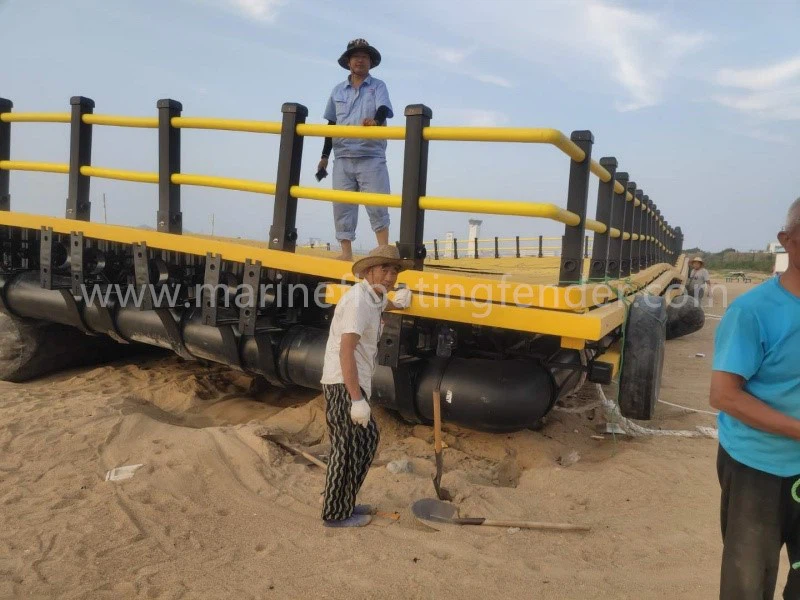
The airbag is used for loading and unloading ships and is a high-strength lifting and loading airbag for heavy objects. It is an innovative product with my country's independent intellectual property rights. This equipment finds extensive application in the launching of ships, as well as in lifting and moving large items, recovering sunken vessels, and aiding in rescue operations. Moreover, it boasts qualities such as minimal financial outlay, swift outcomes, and high levels of safety and dependability The application of marine airbags is less restricted by site and does not require large-scale mechanical equipment, so it can shorten the project cycle and save a lot of money.Following two decades of rigorous testing and refinement, this product has consistently demonstrated its reliability, effectiveness, eco-friendliness, and ease of use, making it a trusted solution for a wide range of applications.
The production and application of marine airbags are mainly carried out with reference to two industry standards: CB/T3795 "Airbags for Ship Top and Launch" and CB/T3837 "Process Requirements for Ship Top and Launch Airbags."
In the "Basic Requirements and Evaluation Methods for Production Conditions of Shipbuilding Enterprises" formulated by the Commission of Science, Technology, and Industry for National Defense, airbag launching is included for the first time as an approved launching method, and it is stipulated that Class II Class I enterprises are allowed to use the airbag launching method. Facilities and equipment utilizing airbags for water launch are also subject to specific requirements.
The existing issue with airbag deployment is that the theoretical framework is significantly less advanced than the practical advancements, leading to disagreements about the safety of airbag deployment.
| Diameter(m) | 1Mpa | 1.2Mpa | 1.5Mpa | 1.8Mpa | 2Mpa | |
| Medium Pressure (4-5) |
Test pressure | 0.14-0.16 | 0.12-0.14 | 0.10-0.12 | 0.08-0.10 | 0.07-0.09 |
| Working pressure | 0.12-0.14 | 0.10-0.12 | 0.08-0.10 | 0.07-0.09 | 0.06-0.08 | |
| High Pressure (6-8) |
Test pressure | 0.22-0.26 | 0.20-0.24 | 0.15-0.20 | 0.13-0.16 | 0.12-0.15 |
| Working pressure | 0.20-0.24 | 0.17-1.22 | 0.13-0.18 | 0.11-0.14 | 0.10-0.13 | |
| Size and Specification: | ||||||
| Diameter(D):From 0.5m to 3.0m | ||||||
| Effective length(EL):From 5.0m to 30.0m | ||||||
| Total length:From 5.0m to 32.0m | ||||||
| Standard numbers of cord layers:From 4layers to 12layers | ||||||
| Note: Customized size available |
According to relevant records, humans began to use the rolling wood principle to carry heavy objects more than 6,000 years ago. Currently, people still use the rolling wood principle extensively in daily production and life to carry heavy objects. The marine airbag is a flexible heavy object carrier designed based on the rolling log principle.
Marine airbag manufacturers have gradually shifted from the lap joint production process to the current integral winding production. Therefore, the airbags that use this production method are more reasonable in structure and have greater safety factors and bearing capacity.
The inflatable burst test is an important means to test the performance of marine airbags.
After more than 20 years of practice, ships using airbag loading and launching technology have developed from flat-bottomed ships with a dead weight of tens of tons to large ships with tens of thousands of tons. Experience has shown that the airbag loading and launching technology for ships is secure. At present, this technology is recognized by the domestic and foreign shipbuilding and port construction industries, and the airbag launching technology has been promoted to a certain extent in the United States, Europe, Southeast Asia, and other countries.
The creative process of architectural design and planning has a profound impact on me, much like the invigorating feeling of a spring morning that I savor with every fiber of my being. As I delve into the world of building design, I find that it captivates my entire essence, much like the sweet and carefree mornings of spring that bring me joy.
The development history of wharf anti-collision equipment is closely related to the technological development level of ships and ports. Compared with the development of ships, the history of anti-collision equipment is concise. It has only been more than 200 years since its simplest type appeared. The advent of rubber anti-collision equipment (rubber fenders) is even shorter, only about 80 years ago.
After the Second World War, the world's shipbuilding industry developed rapidly. The variety of ships grew, ship sizes increased quickly, and trade imports expanded. New types of wharf structures emerged, and the existing wooden bumpers were no longer sufficient for docking ships.. As a result, anti-collision equipment made of other materials (such as rubber fenders, etc.) appeared one after another. The United States first produced and used rubber fenders in 1932, and Europe began to adopt and manufacture rubber fenders in the 1940s. Japan began using it in late 1954, and production began in 1956. Many new large rubber fenders have appeared to meet the needs of supertanker berthing and parking.
Rubber fenders were first tested for production in the 1970s in my country.. After over 30 years, rubber fender production has begun to take shape, and product quality has reached the advanced foreign level, basically meeting the supporting needs of my country's port construction.
Our Service Processes
All our products strictly follow ISO 14409 specifications
Pre-sales Consultancy
1
>>
Confirmation of order
2
>>
Production
3
>>
Multi-Channel Shipping
4
>>
Confirmation of receive
5
>>
After-sale Services
Our factory & quipment


Customer Case Sharing
After many comparisons, the customer finally selected Qingdao Luhang Airbag Fender Co., Ltd., which produced 12 rubber airbags with a diameter of 1.8 meters, an effective length of 12 meters, and seven layers. They were produced and shipped smoothly, and the quality was once again recognized by customers.
Pressure And Airtightness Testing
The test was performed using a full-sized airbag with a diameter of 1.8 meters, an effective length of 12 meters, and seven layers. The require working measure from customer is 0.25Mpa.
Without carrying any load, fill the air bag till the internal pressure till 0.25Mpa. The internal pressure was recorded, and the pressure loss was less than 5% after one hour.
All our products are strictly by ISO standards. Quality is our advantage.


We Are Always At Your Service When You Need
Qingdao Luhang Marine Airbag and Fender Co.,Ltd is located in Jidong Industrial Park,Jimo city,Qingdao.We are a professional manufacture of muli-purpose marine equipment including ship launching and landing airbag,pneumatic rubber fender,EVA foam fender,marine buoys in deep and shallow seas,etc.Through many years'development and accumulation,we have developed to a new high-tach enterprise with an intergration of scientific research and design,product R&D,sales and technical service.With advanced manufacturing equipment,strictly QC, we hare supplying high quality products and after-sale service and widely appraised by domestic and oversea customers.For many years, we have been doing our best to research and development advanced products with a realistic and dedicated attitude.
active members
years experience
National patent
Professional skill
Hot Tags: marine airbag, China marine airbag manufacturers, suppliers, factory, Marine Rubber Airbag, Ship Launching and Docking Airbag, Ship Launching Marine Airbags, Marine Rubber Air Bags, Ship Launching Airbag, Boat Lifting Airbag


