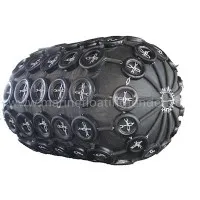


When a ship docks or is moored, it will hit the dock at a certain speed under wind, waves, currents, and other factors. To protect ship-berthing buildings (piers) and ships from damage, a buffer device must be installed between the dock and the boat. This device is usually called an anti-collision device. There are many types of anti-collision equipment, which can be divided into wood, steel, rubber, etc., according to the material, and can be divided into fixed, suspended, floating, etc., according to the installation method.
Rubber fenders are a new type of terminal anti-collision equipment discovered in modern times. The rubber material itself has many advantages, such as good elasticity, corrosion resistance, and long service life, so it has been widely used around the world since the 1960s. Design and usage practices show that rubber fenders are effective shock absorbers and can provide excellent protection for docks and ships.


There are many types of rubber fenders. The main types commonly used at home and abroad are as follows:
1) Cylindrical rubber fender
2) Semi-circular rubber fender
3) Arched rubber fender
4) Drum type rubber fender
5) Floating rubber fender
6) Inflatable rubber fender
7) Other rubber fenders: rotating fenders, tugboat fenders, dock corner fenders, etc.
Architectural design & planning cepteur sint occaecat cupidatat proident, taken possession of my entire soul, like these sweet mornings of spring which I enjoy with my whole...Architectural design & planning cepteur sint occaecat cupidatat proident, taken possession od my entire soul, like these sweet mornings of spring which I enjoy with my whole Lorem ipsum dolor sit ament, consectetur adipisicing elit,sed do eiusmod tempor incididunt labore et dolore magna aliqua. it enim ad minim veniam.

The development history of wharf anti-collision equipment is closely related to the technological development level of ships and ports. Compared with the development of ships, the history of anti-collision equipment is concise. It has only been more than 200 years since its simplest type appeared. The advent of rubber anti-collision equipment (rubber fenders) is even shorter, only about 80 years ago.
After the Second World War, the world's shipbuilding industry developed rapidly. The types of ships continued to increase, the tonnage of ships increased rapidly, and imports became increasingly developed. Light wharf structural types appeared, and the original wooden anti-collision devices could no longer meet the requirements of ship berthing. As a result, anti-collision equipment made of other materials (such as rubber fenders, etc.) appeared one after another. The United States first produced and used rubber fenders in 1932, and Europe began to adopt and manufacture rubber fenders in the 1940s. Japan began using it in late 1954, and production began in 1956. Many new large rubber fenders have appeared to meet the needs of supertanker berthing and parking.
In my country, trial production of rubber fenders began in the 1970s. After over 30 years, rubber fender production has begun to take shape, and product quality has reached the advanced foreign level, basically meeting the supporting needs of my country's port construction.

Rubber fenders have an excellent buffering and protective effect on docks and ships; due to the huge impact force when a ship docks (berthing, parking, or moving), it often causes serious consequences such as damage to ship components, deformation of the hull, or deformation and displacement of the dock. Rubber fenders can absorb this impact energy and protect docks and ships from damage.
In recent years, the importance of anti-collision equipment at docks has become more and more apparent. The tonnage of ships has continued to increase, and the impact and vibration energy has risen sharply. Some large cruise ship docks are built on unprotected open seas. In addition, the design of terminals near the terminal tends to be lightweight structures. All of this has shown that the development of high-energy, low-reaction fenders is significant and urgent.
There are many types of rubber fenders, and their energy absorption principles vary depending on the type. For example, compression fenders rely on the structural deformation of the product after the product is compressed to absorb the adequate impact energy of the ship; shear fenders use the shear deformation of the rubber fender to absorb the proper impact energy of the vessel; rotational compression fenders The rotation and compression deformation of the rubber fender is used to absorb the adequate impact energy of the ship; the inflatable fender uses the compressed air in the rubber body as the buffer medium to absorb the proper impact energy of the ship.
Our Service Processes
All our products strictly follow ISO specifications
Pre-sales Consultancy
1
>>
Confirmation of order
2
>>
Production
3
>>
Multi-Channel Shipping
4
>>
Confirmation of receive
5
>>
After-sale Services
Our factory & quipment


Customer Case Sharing
After many comparisons, the customer finally selected Qingdao Luhang Airbag Fender Co., Ltd., which produced 12 rubber airbags with a diameter of 1.8 meters, an effective length of 12 meters, and seven layers. They were produced and shipped smoothly, and the quality was once again recognized by customers.
Pressure And Airtightness Testing
The test was performed using a full-sized airbag with a diameter of 1.8 meters, an effective length of 12 meters, and seven layers. The require working measure from customer is 0.25Mpa.
Without carrying any load, fill the air bag till the internal pressure till 0.25Mpa. The internal pressure was recorded, and the pressure loss was less than 5% after one hour.
All our products are strictly by ISO standards. Quality is our advantage.

Company Profile

We Are Always At Your Service When You Need
Established in 1988 as a military enterprise, Qingdao LuHang Marine Airbag and Fender Co.,Ltd has a floor area of 40000 m2, building area of 30000 m2, and fixed assets totaling 16 million USD. The company specializes in manufacturing various marine products such as EVA foam filled fender, pneumatic rubber fender, solid rubber fender, sea buoy, Floating Barrier, Machinable deep sea buoyancy material, and Marine rubber airbags. With a strong presence in the Chinese market and a growing global customer base, LUHANG is recognized for its professional manufacturing practices, stringent quality control, and reliable after-sales service.
active members
years experience
National patent
Professional skill
Frequently Asked Questions
Question1: "What kind of certificate can you provide for rubber inflatable fenders?"
Answer: CCS, BV, SGS etc. certificate is available.
Question2: "What's the warranty period of your rubber inflatable fenders ?"
Answer: Our warranty period is 2 years. we will responsible for the repair or replace the new rubber inflatable fenders for you if it proved to be our quality problem.
Question3: "I want to try your rubber dock fender bumper, but I never use it and don't know how to use ,can you help me?"
Answer: Don't worry. We will send instruction book together with rubber inflatable fenders
Question4: "I have ships but don't know how to choose the size of rubber inflatable fenders ,can you help me?"
Answer: Don't worry .We have more than 30 years' experience. Pls tell me information of your ship, we can suggest suitable rubber inflatable fenders size and quantity for you
Question5: "What's the delivery time and payment terms ?"
Answer: Delivery time is based on product model and order quantity. normally it is around 7-15 working days. The payment could paid by T/T, L/C,Alibaba, etc.

Hot Tags: Marine Fender, China Marine Fender manufacturers, suppliers, factory